Search This Blog

Featured Post

Women are Making the Move Into Male-Dominated Jobs

Traditionally male-dominated industries have been growing fastest since December 2016: mining, construction, and transportation and utilitie...

Powered by Blogger.
  • ()
  • ()
Show more

Text Widget

Lorem ipsum dolor sit amet, consectetur adipisicing elit, sed do eiusmod tempor incididunt ut labore et dolore magna aliqua. Ut enim ad minim veniam, quis nostrud exercitation test link ullamco laboris nisi ut aliquip ex ea commodo consequat.

Duis aute irure dolor in reprehenderit in voluptate another link velit esse cillum dolore eu fugiat nulla pariatur.

Label Manager

RECENT WITH THUMBS$type=blogging$m=0$cate=0$sn=0$rm=0$c=4$va=0

Footer Logo

Popular Posts

Pages

Pages

Advertisment

You Are Where You Live

SHARE:

New nationwide data released by the Census Bureau , in collaboration with researchers at Harvard University and Brown University, shows that...

New nationwide data released by the Census Bureau, in collaboration with researchers at Harvard University and Brown University, shows that the neighborhoods in which children grow up matter greatly to their future well being. The research, which predicts outcomes for children in each census tract, builds on previously released findings at the county level.

Nationwide, there are large disparities in outcomes between children raised in poor families (those whose household income is at the 25th percentile of the national income distribution) in some of the nation�s largest urban areas (e.g. Chicago, the Bronx, low-income neighborhoods in Manhattan, etc) and children raised in poor families in larger cities and other suburban counties. For example, children raised in low-income families in the Minneapolis suburbs end up making four times more in adulthood than children raised in low-income households in some Memphis neighborhoods.

But local disparities between what seem like similar neighborhoods is striking for policymakers. Even within Ann Arbor, children who grew up in poor families around parts of Elm Street and Hill Street are expected to earn about $54,000 a year in their adult households, whereas in the neighborhoring tract, which covers parts of Packard Street and South State Street, children who grew up in low-income households are expected to earn about $26,000 a year in their adult households. The big takeaway: children�s immediate environments (as close as within half a mile of a child�s home) affect a range of their adult outcomes such as income, incarceration rate, teenage pregnancy and college graduation.
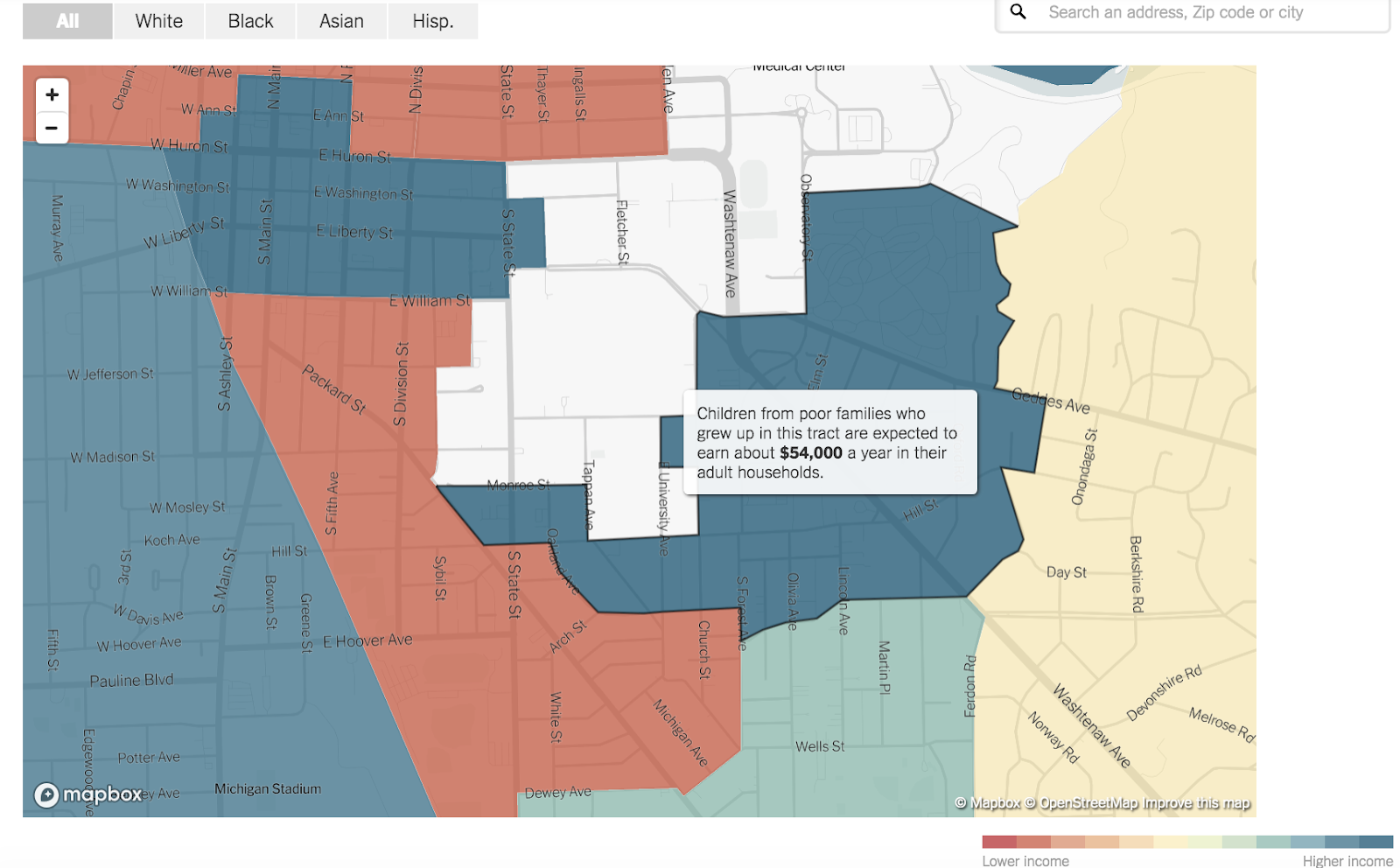
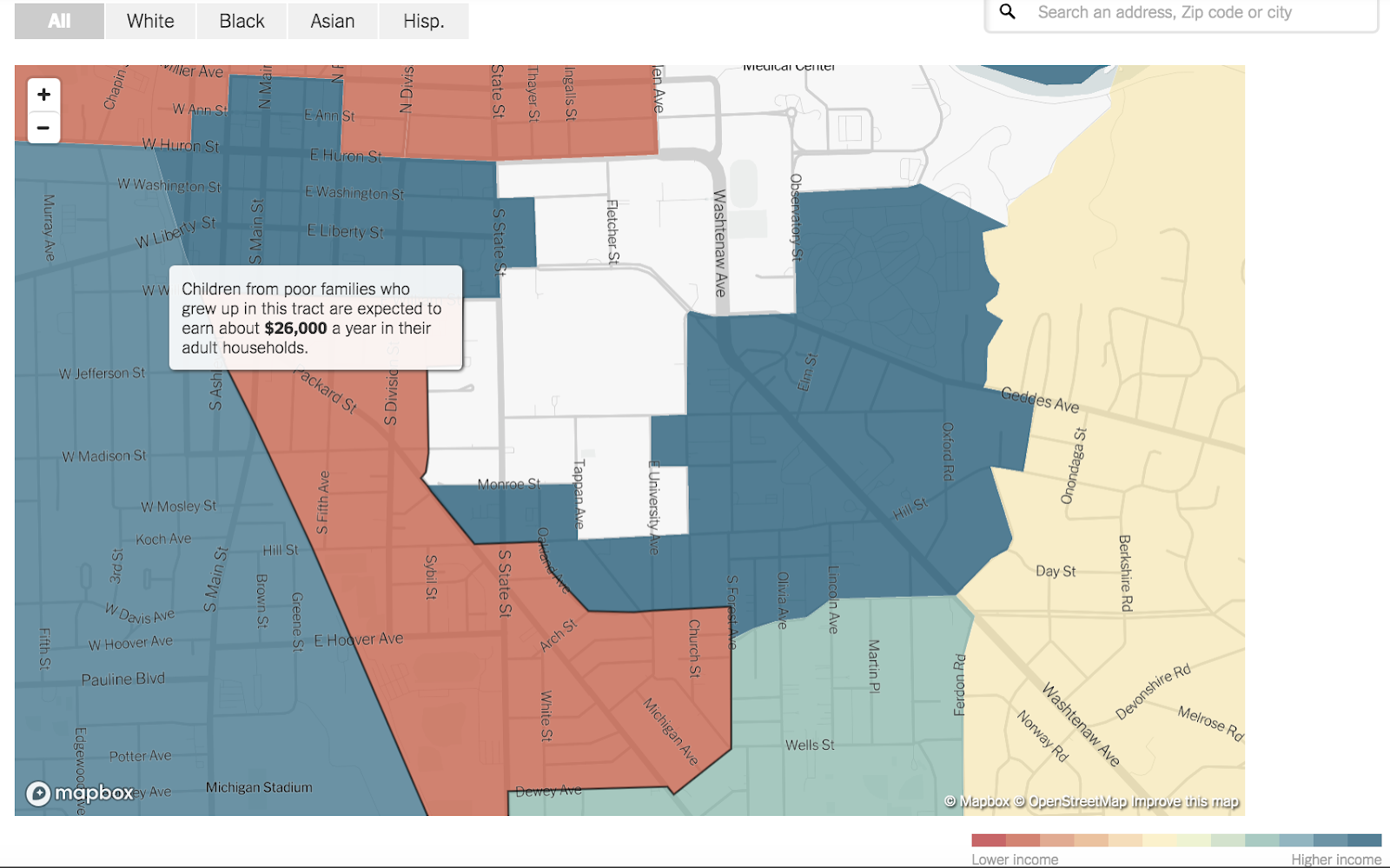
The census tract-level atlas of children�s outcomes was constructed using de-identified data from the 2000 and 2010 Censuses linked to data from federal income tax returns and the 2005- 2015 American Community Surveys (ACS). Focusing on approximately 20.5 million children born between 1978 - 1983 in the United States and authorized childhood immigrants from the same cohorts, the researchers obtained information on their income, parental characteristics, where they grew up, and other variables. Many of the children have since moved away, but the researchers map their outcomes back to the census tracts where they grew up. To account for children who grew up in more than a single census tract, children are assigned weights according to the fraction of their childhood spent in each tract.

The researchers argue that the study allows policymakers to identify areas that are likely to produce good outcomes for the children who grow up there; areas where there are high opportunities for upward mobility. Interestingly, the researchers believe that the variation in outcome is driven by the neighborhoods themselves, not by differences in what brings people to live in them (e.g. low-income families clustering in the same neighborhoods). Assuming their model holds, this map could help policy makers identify high-opportunity areas to channel government programs (such as Head Start centers) or community grants, instead of just channeling funding to areas where neighborhood poverty is prevalent. The Seattle and King County housing authorities are hoping to use housing voucher programs to move families to where they believe opportunity already exists.

Further reading:

COMMENTS

INNER POST ADS 2

Thanks for reading OUR Post! DID YOU ENJOY THIS ARTICLE? Subscribe to OUR Blog and you'll never miss a single post.

Only for Admin

Name

1965,1,2016 presidential election,1,2018,1,affordable housing,1,african american,1,attractiveness,1,beauty bias,1,blind hiring,1,canada,1,CDC,1,cell phone,1,census,1,chicago,1,china,1,civil rights,1,climate,1,college,1,community,1,condoms,1,contraception,1,contraceptive practices,1,Cuba,1,data,2,data in the news,1,data visualization,1,death penalty,1,death row,1,Death Sentences,1,debates,1,demographics,1,detroit,2,diffuse status,1,discrimination,2,disease,1,drug,1,elections,1,environment,2,eu,1,family,1,family formation,1,female,1,females,1,film,1,Flint (Michigan),1,fossil fuel,1,gallup,3,Gen Z,1,gender,3,gender discrimination,1,gender gap,1,gender wage gap,1,gentrification,1,GOP,1,guns,1,gunshots,1,health care,1,health care costs,1,heroin,1,hookups,1,housing,2,housing prices,1,Hungary,1,Hurricane Katrina,1,ideology,1,immigration,2,immigration reform,1,incarceration,1,income,1,intercourse,1,interdependence theory,1,internet,1,iowa,1,Iran,1,manufacturing,1,medical residents,1,medicine,1,mental health,1,midterm elections,1,migration,1,millenials,1,Millennials,1,missing men,1,mortality,1,neighborhood,1,New Orleans,1,new york city,1,nuclear weapons,1,offshoring,2,opportunity,1,organizational behavior,1,organizational context,1,oscars,1,paid maternal leave,1,paris,1,partisanship,1,peers,1,pew,1,Pew Research Center,4,police shootings,1,political affiliation,1,polling methodology,1,population,1,post-millenials,1,price,1,public health,2,public opinion,3,race,2,racial discrimination,1,racial disparities,1,random digit polling,1,reshoring,1,risk-taking behavior,1,sampling error,1,selection decisions,1,sexual behavior,1,ShotSpotter,1,socioeconomic status,1,status,1,status generalization theory,1,stock market,1,student debt,1,surgery,1,tax evasion,1,taxes,1,technology,1,Teens,1,The New York Times,1,The Upshot,1,The Washington Post,1,threat,1,trade,1,transportation,1,Trudeau,1,undergraduates,1,upward mobility,1,urban areas,1,US Census Bureau,1,violence,2,visas,1,voting,1,water,1,wealth,1,wealth distribution,1,white flight,1,women,1,women in film,1,work,1,workforce,2,
ltr
item
ohona: You Are Where You Live
You Are Where You Live
https://lh5.googleusercontent.com/s4ciXq2yI8EYhNb7z5IVaP5ZKzT-XuLQPRC1atdLmDTWFm7vMDnnhijnkl9dYdutRRrbY7Qg6wCJW30Hlaxrol5vPZoMjWIP_gD_MyESqTp6xiSNDojkwU1rMc-u-mgBWzvj2Qmw
https://lh5.googleusercontent.com/s4ciXq2yI8EYhNb7z5IVaP5ZKzT-XuLQPRC1atdLmDTWFm7vMDnnhijnkl9dYdutRRrbY7Qg6wCJW30Hlaxrol5vPZoMjWIP_gD_MyESqTp6xiSNDojkwU1rMc-u-mgBWzvj2Qmw=s72-c
ohona
https://ohona1.blogspot.com/2018/11/you-are-where-you-live.html
https://ohona1.blogspot.com/
https://ohona1.blogspot.com/2018/11/you-are-where-you-live.html
true
1338274072150124194
UTF-8
Loaded All Posts Not found any posts VIEW ALL Readmore Reply Cancel reply Delete By Home PAGES POSTS View All RECOMMENDED FOR YOU LABEL ARCHIVE SEARCH ALL POSTS Not found any post match with your request Back Home Sunday Monday Tuesday Wednesday Thursday Friday Saturday Sun Mon Tue Wed Thu Fri Sat January February March April May June July August September October November December Jan Feb Mar Apr May Jun Jul Aug Sep Oct Nov Dec just now 1 minute ago $$1$$ minutes ago 1 hour ago $$1$$ hours ago Yesterday $$1$$ days ago $$1$$ weeks ago more than 5 weeks ago Followers Follow THIS CONTENT IS PREMIUM Please share to unlock Copy All Code Select All Code All codes were copied to your clipboard Can not copy the codes / texts, please press [CTRL]+[C] (or CMD+C with Mac) to copy